
Transform Your Community
Through Restorative Justice
“Never doubt that a small group of thoughtful, committed citizens can change the world; indeed, it’s the only thing that ever has.”
Our Approach to Learning
RJIM's training programs don't just teach skills—they transform how people understand justice, community, and their role in creating a more equitable world.
We believe that meaningful change happens through relationships and connections, not through one-size-fits-all solutions. Our approach combines:
Immersive experiences that engage your heart and mind
Practical skills you can apply in your community immediately
Deep understanding of systemic issues and root causes of harm
Supportive community to sustain your practice and growth
What Makes Our Training Different
Our "interdependent studies" model brings together:
Teaching that builds a solid foundation in restorative principles
Listening to diverse perspectives and lived experiences
Practicing concrete skills through real-world scenarios
Connecting with others on similar journeys of transformation
We create brave spaces where participants can explore challenging ideas, practice new skills, and build relationships that sustain this work long after the training ends.
-
This 2-day workshop explores the foundational principles of restorative justice (RJ) and restorative practices. We'll delve into the meaning of restorative justice, its origins, its potential applications, and how it can benefit you and your community.
Key Topics Covered:
Foundational principles of restorative justice
The meaning, roots, and utilization of restorative justice
Multiple frameworks and models of restorative practices and responding to harm
Challenging preconceived notions of harm, repair, and healing
Circle practice and community-building circles
By the end of this training, you will:
Understand what restorative justice means and how it can be used as an alternative to the criminal legal system
Learn multiple theories/models that ground this work in our values
Learn what a circle is and how to create a community-building circle
-
Building on the foundations established in our introductory workshop, this advanced training focuses on developing the skills needed to facilitate restorative processes and circles. This training is designed for those who have completed the Level 1 workshop or have equivalent experience with restorative justice practices.
Key Topics Covered:
Advanced circle facilitation techniques
Facilitating harm repair processes
Managing complex dynamics in restorative settings
Trauma-informed approaches to facilitation
Adapting restorative practices to different contexts
By the end of this training, you will:
Gain confidence in facilitating various types of circles and restorative processes
Develop strategies for addressing challenges that may arise during facilitation
Learn how to create and maintain safe spaces for difficult conversations
Understand how to apply restorative principles in diverse settings
Featured Programs
Additional Specialized Training
Power, Belonging, and Justice: Creating Equity in Your Community
Explore how power dynamics affect community relationships and learn strategies for creating more equitable spaces through restorative approaches.
Relationships as Healing
Examine the healing potential of relationships and how restorative practices can strengthen connection in communities affected by harm.
Restorative Justice as Public Safety
Learn how restorative approaches can enhance community safety and well-being without relying on punitive systems.
Abolitionist Frameworks
Understand the connections between restorative justice and abolitionist movements working toward community-based responses to harm.
Custom Consulting for Organizations
Move from Workshop to Real-World Implementation
We partner with organizations to develop and implement restorative approaches tailored to your specific context. Our approach focuses on building internal capacity and sustainable change.
Who We Work With:
Schools & Educational Institutions
Whole-school implementation strategies
Alternatives to suspension and expulsion
Classroom community-building
Staff training and coaching
Justice System Agencies
Diversion program development
Court-connected restorative processes
System reform initiatives
Cross-agency collaboration
Community Organizations
Conflict resolution frameworks
Harm response protocols
Community circle implementation
Staff and volunteer training
Workplaces & Businesses
Organizational culture transformation
Conflict resolution processes
Leadership development
Team-building approaches
Our Commitment to Accessibility
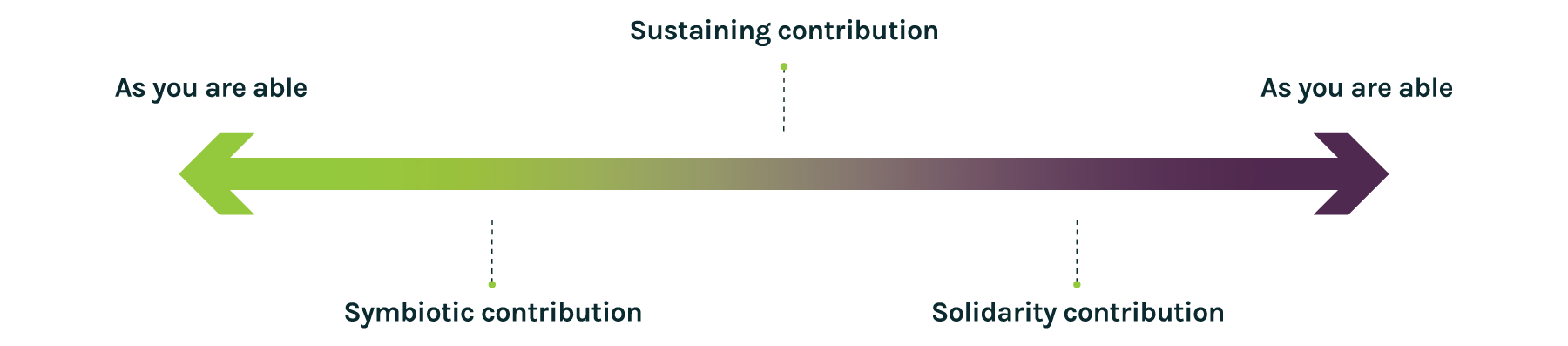
We believe that restorative justice work should be accessible to all communities. Our sliding scale pricing structure reflects this commitment:
Symbiotic Contribution
For groups with limited resources, such as those led by individuals with lived experience of systemic oppression, QTBIPOC communities, and those facing housing or employment insecurity.
Example: $2400 for the 2-Day Introduction to RJ Workshop
Sustaining Contribution
Represents the estimated real cost of the program and is intended for groups without direct lived experience of systemic oppression and public organizations.
Example: $2800 for the 2-Day Introduction to RJ Workshop
Solidarity Contribution
For groups with greater financial capacity, such as private organizations and those seeking to support the work of restorative justice.
Example: $3000 for the 2-Day Introduction to RJ Workshop
The contribution levels for symbiotic and solidarity contributions are flexible, allowing participants to give according to their capacity.